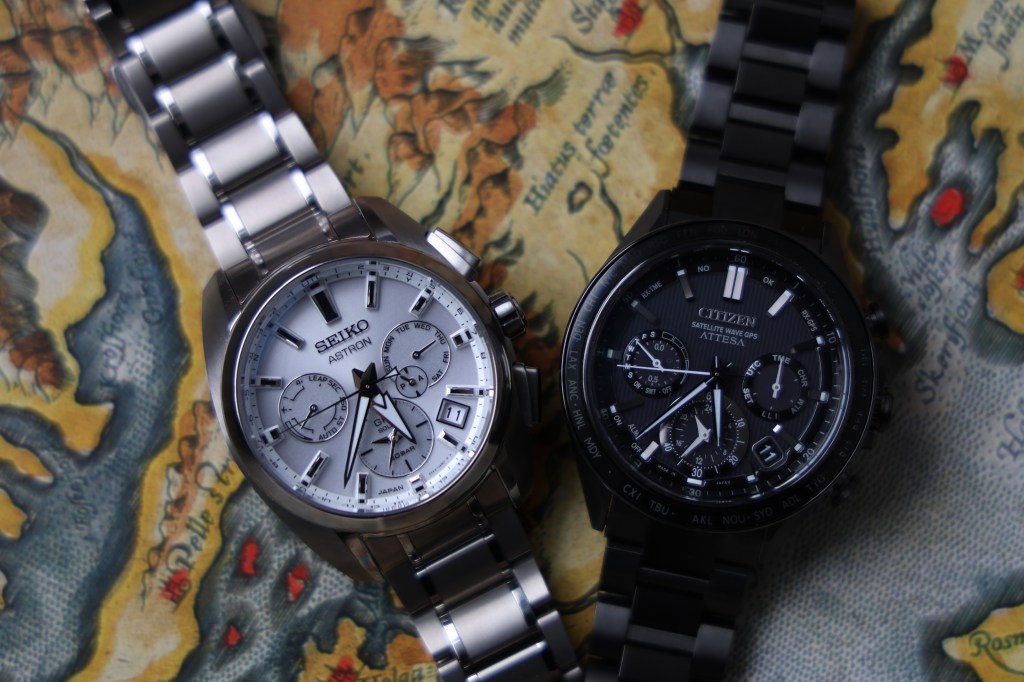
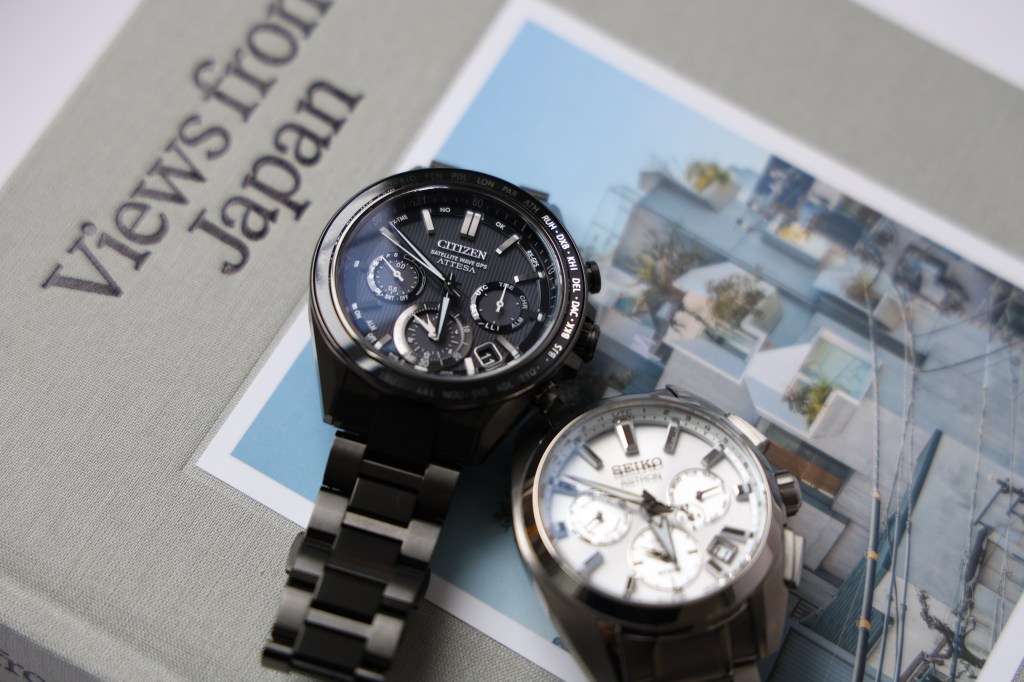
Last week, I wrote a bit on my thoughts for a well built, affordable quartz watch. But what if we wanted to spend a little more on a quartz watch? Quite a bit more, actually–roughly ten times more. What we get are a pair of technologically advanced watches with modules that pull the atomic time from the GPS satellites up in orbit. Outside of digital and smart watches categories, watches like these can be seen as the bleeding edge of watch manufacture. Today we are looking at the Citizen Attesa CC4055-65E and Seiko Astron SSH063.

If I were to design a thoroughly modern watch for modern times, one metal comes to mind: titanium. Both of these watches are built from titanium, but both of them feature different finishes that really set them apart from each other. The Seiko really shows off the company’s attention to detail in case finishing. There are contrasting brushed and polished areas that really work well together. A popular sound bite from watch media is that titanium is notoriously hard to finish. I suppose it depends on the grade of titanium, but you couldn’t tell from looking at the Astron. The lines are crisp and razor sharp, appropriate for the price point.


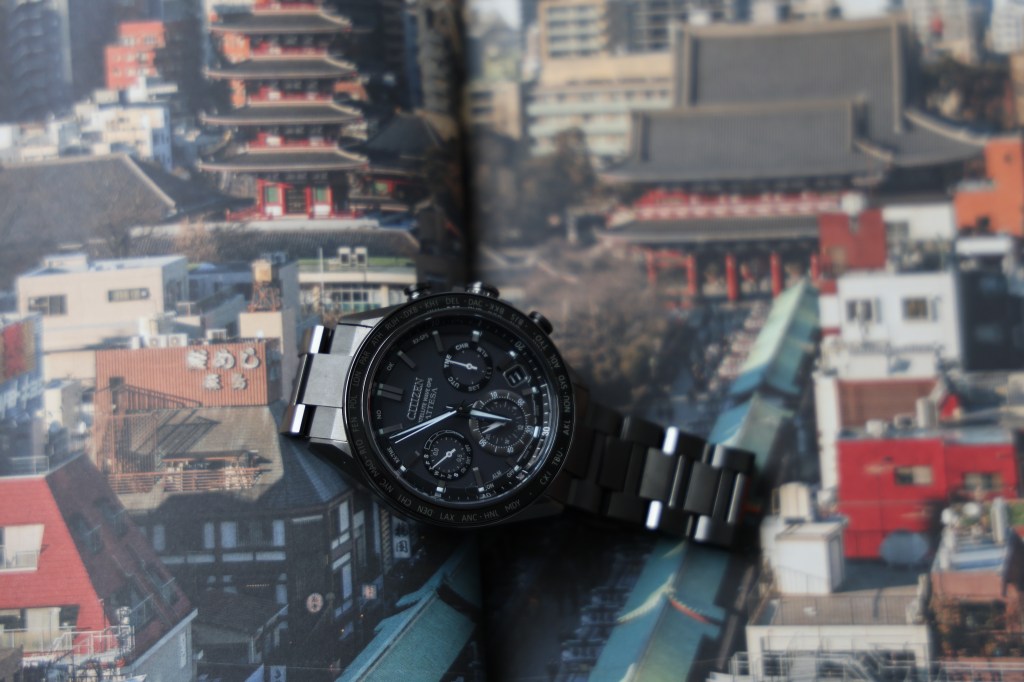
The titanium of the Citizen, by contrast, is fully coated in diamond-like carbon (DLC). The result is a super light watch with menacing wrist presence. While the watch does not feature any polished surfaces on the case and bracelet, there are contrasting satinized and brushed surfaces that give the monotone watch some visual interest. If at all possible, the piece is equal parts stealthy and striking. Admittedly, when I started my interest in this hobby, coated watches did not really appeal to me. Furthermore, I was never really interested in chronograph watches. This Citizen Attesa really changed both of those things for me. I find that a whole branch of coated watches has now opened up to me.
Functionally, the two watches are very similar, though the module in the Astron lacks a few of the extra bells and whistles of the Attesa. Both watches periodically leverage the GPS network and retrieve timezone information to automatically adjust the time. Combined with the fact that both watches are solar powered, the Astron and Attesa really embody the ethos of “set it and forget it.” By having access to all timezones around the globe, these two also represent the perfect travel companions. Imagine landing after your 16-hour flight and, instead of looking at your phone, you press a button and instantly know the time. Even better, you can store your home time on a sub dial so you can keep tabs on everything you left behind. I was lucky enough to have the Astron with me on one of my last international trips. It was not far, but Iceland seemed like a world away. Iceland uses Greenwich Mean Time (GMT) as its standard time, sharing the timezone with places like the United Kingdom, Portugal, Ghana, Mauritania, and the Faroe Islands. The watch performed as expected and I was able to time my calls back home to my young son–always remember to call your kids!

But, as I alluded to earlier, you could always just look at your phone… While this is definitely a valid point, there are times and places where reaching into your pocket for your phone probably isn’t the best idea. For example, climbing on an unpronounceable glacier in the south of Iceland. A quick glance at your wrist would be sufficient and prudent. Of course, there’s also all the baggage that comes with checking your phone: the messages, the voicemails, and the distractions. For those of us chasing the “romance” of adventure, real or not, I think there are few better options to put on your wrist.



| Reference | SSH063/CC4055-65E |
| MSRP | $2,500/$2,695 |
| Case Size | 42.8mm/44.6mm |
| Lug-to-Lug | 48.8mm/50mm |
| Lug Width | 21mm/22mm |
| Materials | Titanium/DLC coated Titanium |
Photographs by @OllieandAlliePhotography


 CWhatWatch
Leave a comment